

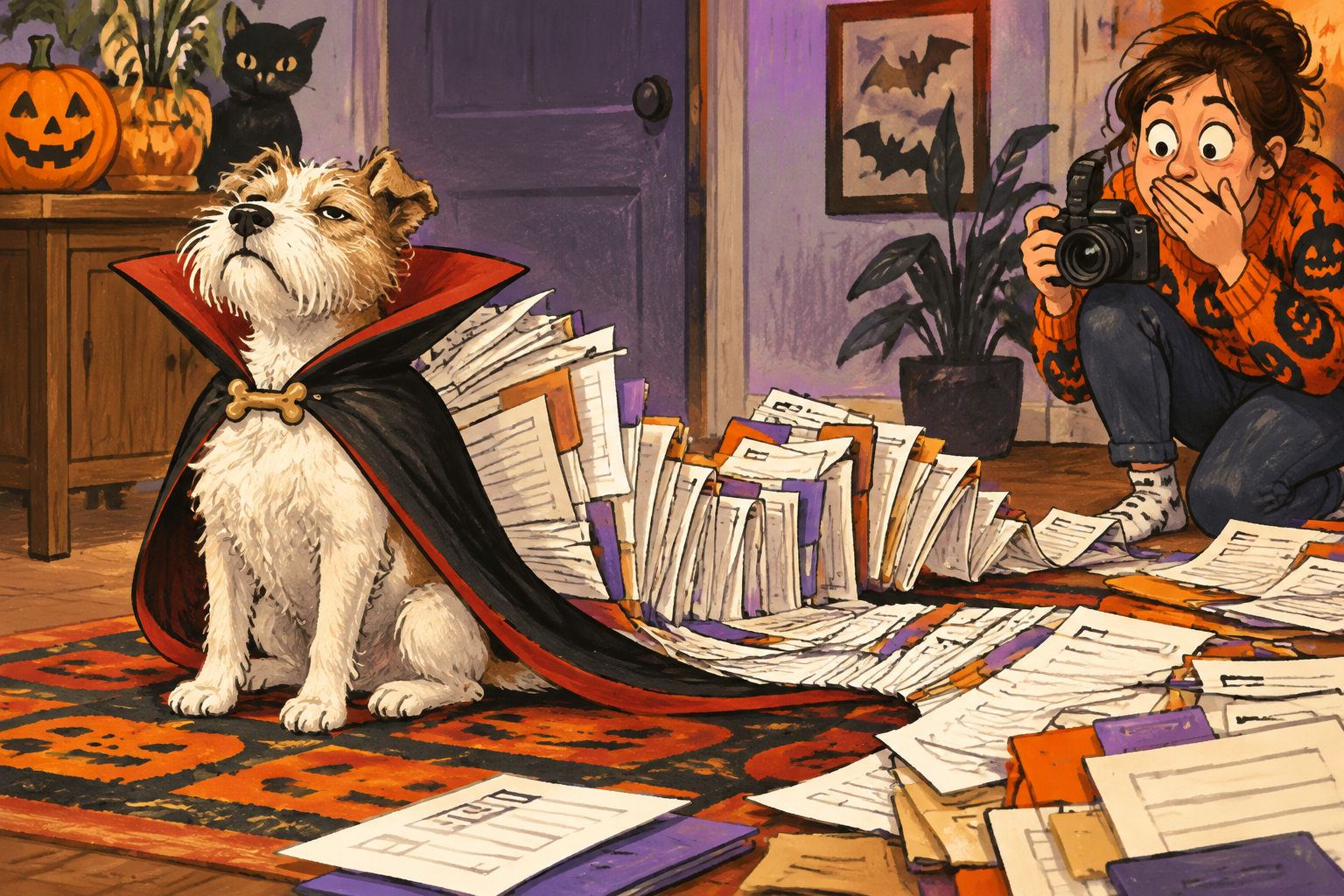
The costume looks perfect in the photo. Then your dog tries to sit and discovers that the cape has become a small, wearable administrative problem.
Before the camera comes out, try a quick comfort check: walk, sit, settle. In a familiar, quiet spot, see how your dog moves in the outfit, whether it shifts or catches, and whether they can relax as they usually do. It’s an editorial shortcut—not a scientific test, a safety guarantee or a way to prove your dog is enjoying the occasion. It is, however, a much better starting point than judging a costume while your dog stands still like a tiny runway model.
The 30-second check: walk, sit, settle 🐾
Keep the first try brief and low-key. Let your dog sniff the costume, then put it on only if they’re comfortable with the process. You don’t need to race a timer; “30 seconds” is a handy reminder to check the basics before a photo session turns into an event.
- Walk: Invite your dog to take a few ordinary steps on a familiar, uncluttered surface. Look for a natural stride, not a perfect performance.
- Sit: If your dog normally sits readily, see whether they can do so without fabric pulling, bunching or sliding under them. Don’t keep cueing if they don’t want to sit.
- Settle: Give them a moment to stand, lie down or relax in their usual way. A dog who freezes rigidly is not necessarily settled; stillness alone doesn’t tell you they’re comfortable.
Notice the whole picture: movement, posture, the fit of the outfit and how your dog responds compared with their normal behavior. If something seems off, adjust the costume, choose a simpler accessory or take it off. There is no Halloween bonus for completing all three steps.
Judge the costume on a moving dog, not a product photo 🎃
A costume can look roomy on a hanger and become unexpectedly ambitious once a dog bends, turns or sits. Check the places where movement happens: around the shoulders and legs, under the belly, at the chest and wherever a strap or seam rests against the body. Look for rubbing, tight spots, twisted fabric, bunching and loose pieces that might catch or get underfoot.
Then watch your dog move. Does a cape trail across the floor when they sit? Does a hood shift over their eyes when they turn? Does a costume leg ride up or twist around an actual leg? A garment can look fine from the front and quietly interfere from the side. A quick turn in place can reveal more than a dozen posed photos.
If you spot a simple problem, take the costume off first and check whether a strap is twisted or the garment has shifted. Reposition it, or adjust a fastener if it is designed to be adjustable, then see how your dog moves again. Don’t pin, tape or tie extra fabric into place, and don’t leave loose ends that could catch or be chewed. If the fit still seems awkward, the easiest fix is to choose something simpler—or call the costume retired.
Keep an eye on anything that dangles, trails or can be mouthed. Remove pieces that appear likely to catch, trip your dog or be chewed. Supervise while any costume is on, and take it off when the photo is done. A costume that fits for a brief picture is not automatically suitable for a longer outing.
Costume-standstill trap: If your dog looks splendid while standing but can’t comfortably sit, turn or move, the outfit has not passed just because the photo is adorable.
The ordinary-life test: can your dog still be a dog?
Think about what your dog usually does in a few minutes at home. Can they walk naturally, turn to look at you, lower their head and settle in their normal way? Does the outfit stay out of their eyes and away from their feet? If it interferes with ordinary movement or blocks their view, adjust it or take it off rather than asking them to push through.
This matters especially with capes and long skirts. The cape can be completely innocent while the dog is standing, then turn into a full-length blanket the instant they sit. If it bunches beneath them or trails where they step, it isn’t a good fit for that dog in that moment. A shorter or simpler option may work better; if not, the costume can retire with dignity.
And keep the photo outfit separate from walking gear. A costume that works for a supervised snapshot at home may be awkward outside, where your dog needs to move freely and notice the world. Don’t assume a Halloween outfit can substitute for normal walking equipment. If you’re considering wearing anything on a walk, assess it for that specific use—and skip it if it restricts movement or vision.
Read the response without pretending to read minds
There is no single pose that proves a dog is happy or unhappy. Instead, compare what you see with your dog’s usual behavior. Do they move and rest much as they normally do? Or do they seem unusually still, keep trying to get away from the outfit, paw at it, or repeatedly shake or turn to reach it? Those observations don’t reveal exactly what your dog is thinking, but they’re useful reasons to pause and reassess.
Pay attention to the costume as well as the dog. Maybe a strap is twisted, a sleeve sits oddly or the hood has shifted. You can take the outfit off, check the fit and offer a simpler option. If your dog remains uncomfortable, stop there. Don’t hold them in place, repeatedly dress them again or treat tolerance as a Halloween requirement.
One dog may stroll around in a loose bandana as if it is an important appointment. Another may freeze the moment a cape appears, like a very small, very disappointed statue. Neither needs to be turned into the other. Your dog’s response is more useful than your matching-family concept, your purchase receipt or the fact that the hat completes the outfit.
A quick decision path for costume night 📸
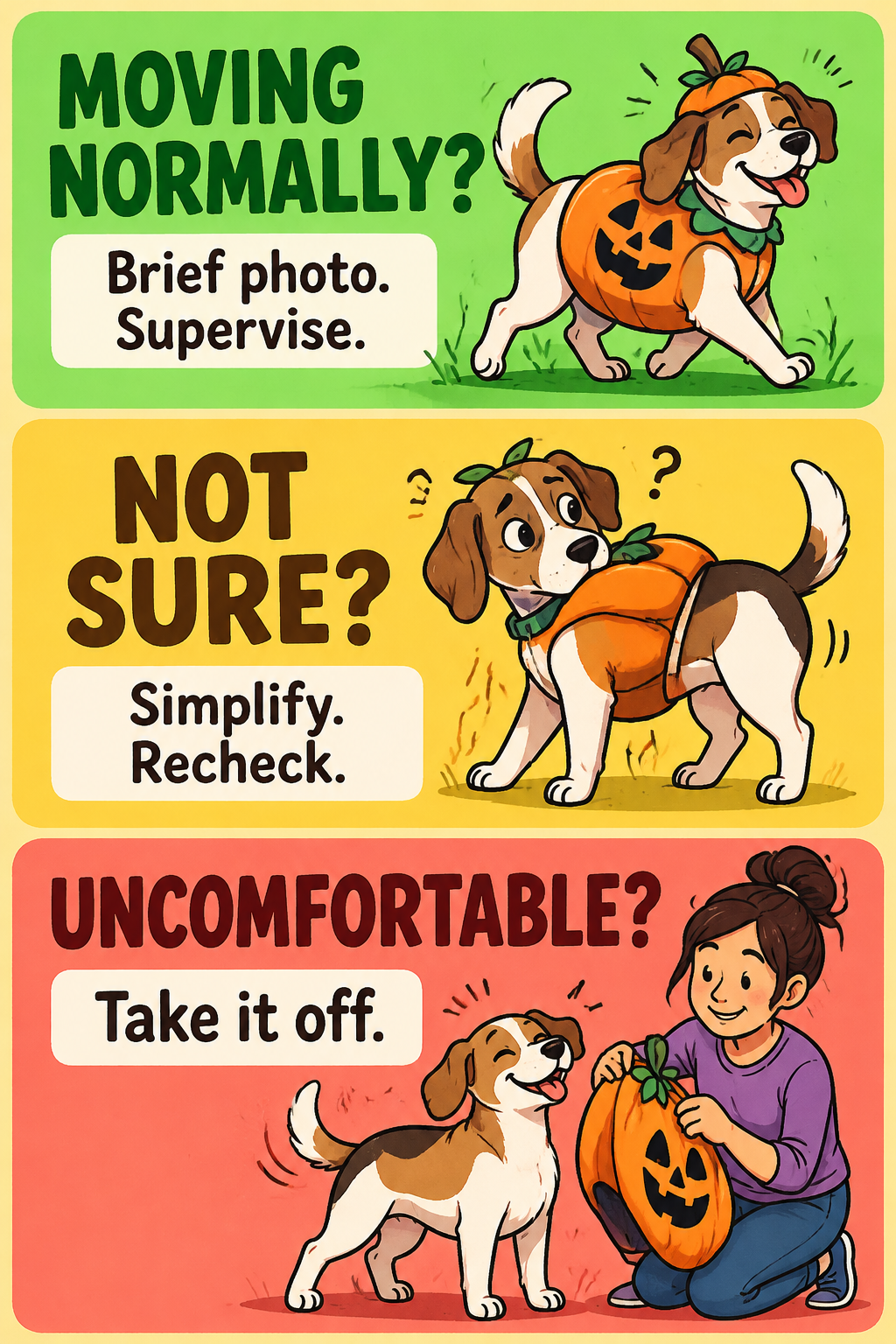
- Looks and moves normally: If the fit seems comfortable and your dog is behaving much as usual, take a brief, supervised photo. Keep watching; one successful check doesn’t guarantee the outfit will stay comfortable.
- You’re not sure: Make one simple adjustment, or try something less involved, such as an easy-to-remove bandana or a festive collar that your dog already tolerates. Recheck movement rather than relying on the mirror.
- Your dog seems uncomfortable or the outfit interferes: Take it off. Choose an accessory they accept, or take the costume-free photo.
Notice the words “brief” and “supervised.” A costume isn’t something to leave on while you step away, get the treats, arrange the props and answer the door. Remove it after the photo—or sooner if your dog seems uncomfortable, the outfit shifts or they start trying to chew it.
Make the photo session about the dog, not the set
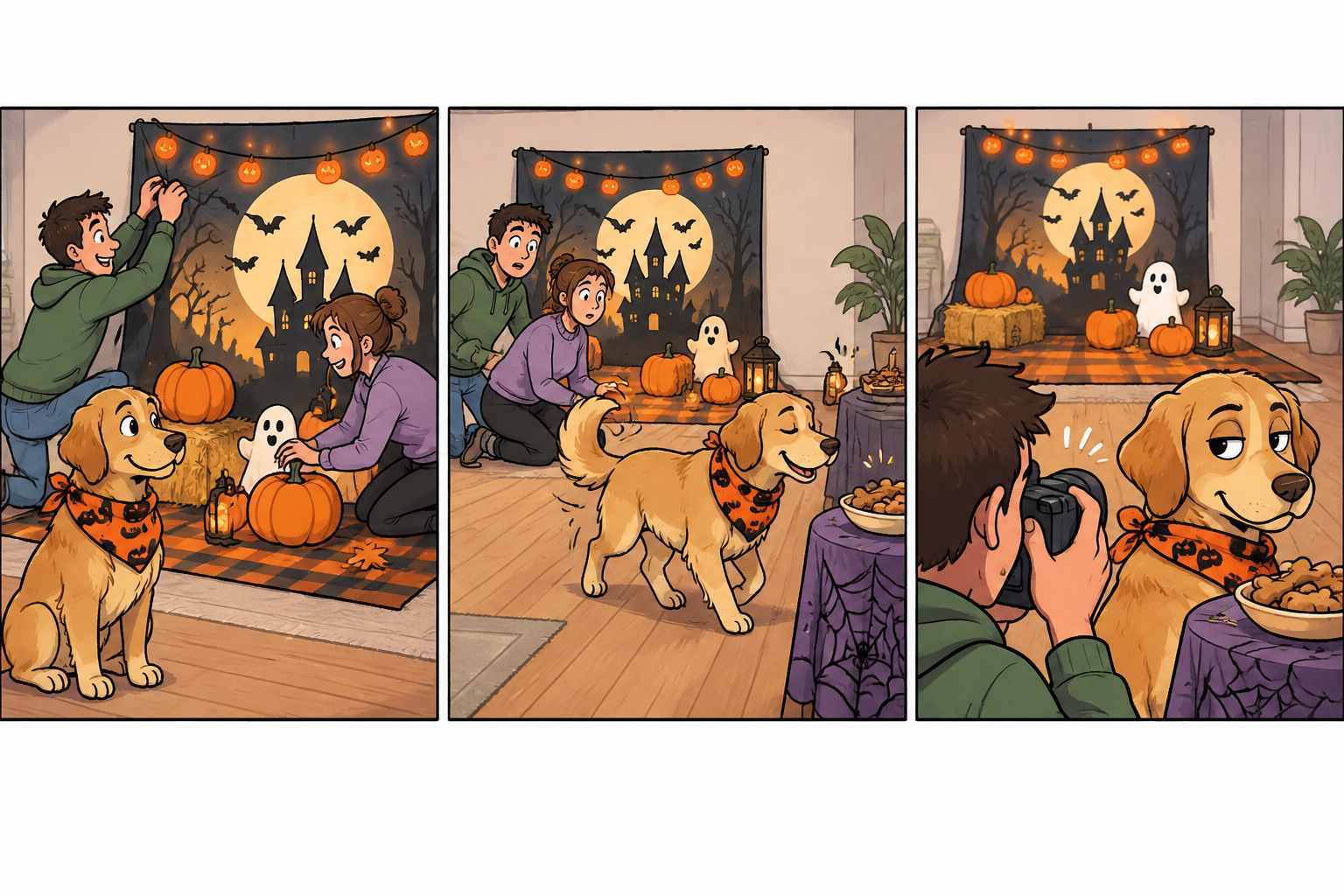
Set up the camera and props before dressing your dog. Keep the room familiar and the session short. Let your dog take breaks, move away or opt out; don’t keep repositioning them for the one frame where every human is smiling and the dog is facing the correct direction. That frame is a myth anyway. There is always one family member blinking, one crooked hat and one dog already halfway to the snack table.
The best photo may be the dog leaving the set while the humans are still arranging props. It may also be the picture where they wear the bandana for six seconds, or the completely costume-free shot where they look most like themselves. Those are not consolation prizes. They’re the version of Halloween that fits.
Reader-photo invitation: Share a brief, supervised costume moment—or a costume-free Halloween portrait. The bandana, the dramatic cape and the excellent uncostumed side-eye all belong in the gallery.
If your dog would rather skip the outfit, they can still be part of a lovely Halloween. We’ve shared more ideas in A Dog-Friendly Halloween Doesn’t Have to Include a Costume. For costume night, though, start with the walk, sit and settle. If the outfit lets your dog move comfortably, you may have a photo. If not, take the costume off—and let the dog keep the final word.


Leave a Reply
You must be logged in to post a comment.