

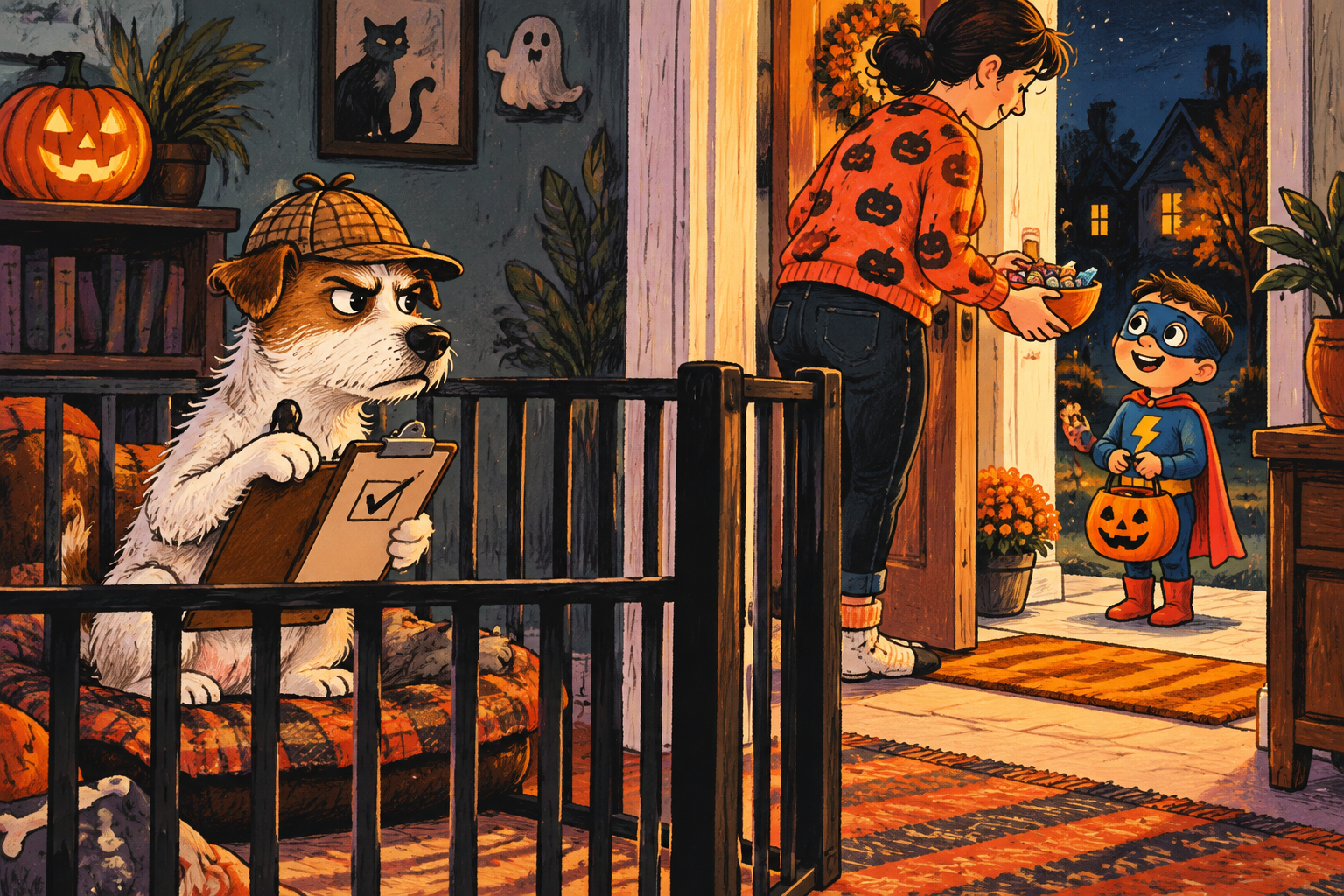
The door opens for one small superhero—and suddenly your dog is convinced they’ve been appointed Director of Knock Investigations, with zero candy-handling authority. There’s a bowl in one hand, a guest in a mask on the step, and a dog trying to supervise the entire operation from the hallway. Welcome to Halloween’s least rehearsed dance number.
A little household choreography can make the evening more manageable. The goal isn’t a silent dog, a flawless greeting or a magical personality transplant by October 31. It’s a workable plan for who handles the door, where the dog will be, and what everyone does when the next knock arrives.
Halloween is two weeks away: enough time to choose a setup and test the route once, without turning your living room into a full-scale security exercise. 🐾
First decision: join the party, or choose a quieter night? 🎃
Some dogs are comfortable with a steady stream of visitors. Others find the knocking, costumes, voices or repeated door movement difficult. And some are fine for three knocks, then decide the evening has gone on quite long enough. You don’t have to make your dog part of the festivities for it to count as a dog-friendly Halloween.
Choose the option that suits your dog and your home:
- Dog included: Your dog can be near the household activity, with a clear boundary between them and the open doorway. Choose this only if your dog is comfortable with the arrangement; visitors don’t have to become dog greeters.
- Dog in a quieter spot: Settle them in a familiar, comfortable room or area away from the entrance, if that space works for them. Their usual bed, water and familiar comforts may help. Don’t spring a new or uncomfortable confinement plan on them Halloween night.
- No door traffic: If the setup doesn’t feel workable, opt out. Make other plans for answering the door, or keep the evening quiet. A low-key Halloween is a perfectly legitimate household tradition.
If you’re looking for more ways to keep the holiday comfortable for your dog, see a dog-friendly Halloween that doesn’t need a costume.
Give everyone a job before the first knock
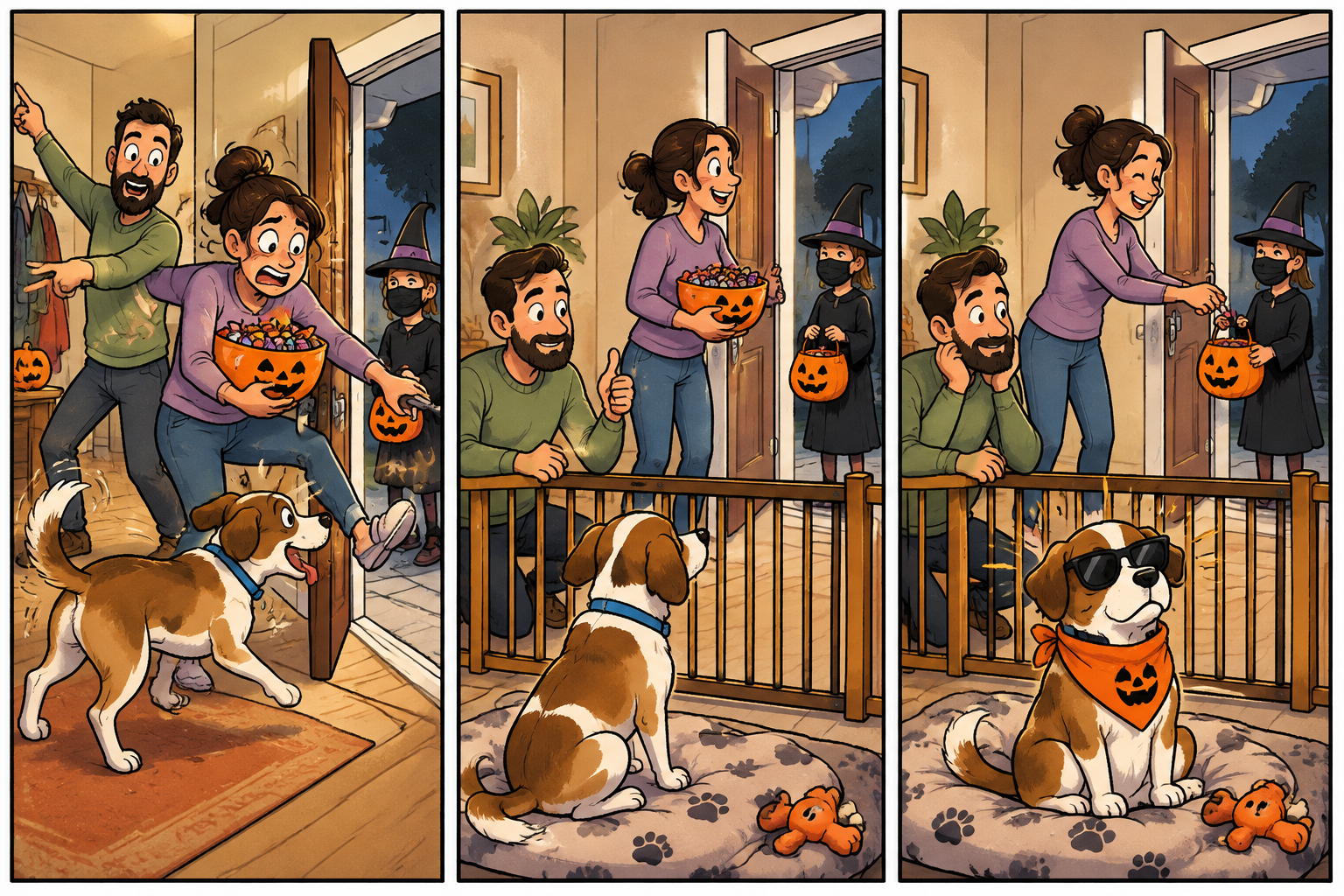
The classic doorway ballet features one person holding the door, one holding the candy bowl, and one realizing the dog has already reached the hallway. Assigning roles in advance is less theatrical—and much more useful.
- Door-answerer: The person who opens the door and manages the guest exchange.
- Dog-watcher: The person responsible for the dog’s location and for checking that the plan is still working.
- Guest guide, if needed: The person who reminds visitors to wait rather than opening the door or greeting the dog without an invitation. In a small household, the door-answerer can take this role too.
In a family, name the actual people rather than assigning vague duties to “someone.” If children are helping, let an adult keep responsibility for the dog and the door. If you’re answering solo, decide in advance whether you can manage the door while the dog is in their chosen spot. If that doesn’t seem realistic, reduce or skip the door traffic instead of improvising with the door open.
Guest note: “Please wait for me to open the door, and don’t greet or feed the dog unless I invite you to. Thank you!”
Pick the dog’s place—and map the guest route
Think about the route people take, not just the spot where the dog starts. Can a guest see the dog and open an interior door? Does the hallway lead straight to the front entrance? Where will the dog be while the door-answerer hands over candy?
A comfortable room with a closed door may be the simplest arrangement in one home. In another, a familiar gate or other existing barrier may create separation while allowing the dog to stay nearer to the household. A gate is optional, not a requirement—and it only helps if it’s appropriate for your dog and reliably keeps the route clear. Don’t assume a barrier will contain a dog who can push past it, jump over it or become distressed by it.
In a home with a front hall, check whether the dog can reach the entrance as the door opens. In an apartment, the shared corridor is part of the doorway picture: plan so the dog isn’t loose in the hall when visitors arrive, and don’t let a guest step into the corridor to meet the dog unless you’ve deliberately arranged a suitable greeting. If the dog’s only comfortable spot is near the entrance, consider whether a closed interior door or a different way of handling visitors could make the route manageable. If not, a quieter evening may be the better fit.
Before Halloween, walk the route once: dog to their spot, human to the door, guest to the handoff point, and everyone back again. Put the candy bowl within the door-answerer’s reach and beyond the dog’s reach. No elaborate kit required; sometimes the sophisticated solution is simply “dog settled somewhere comfortable, door handled by a human, candy bowl placed sensibly.”
Your printable door-duty plan 📝
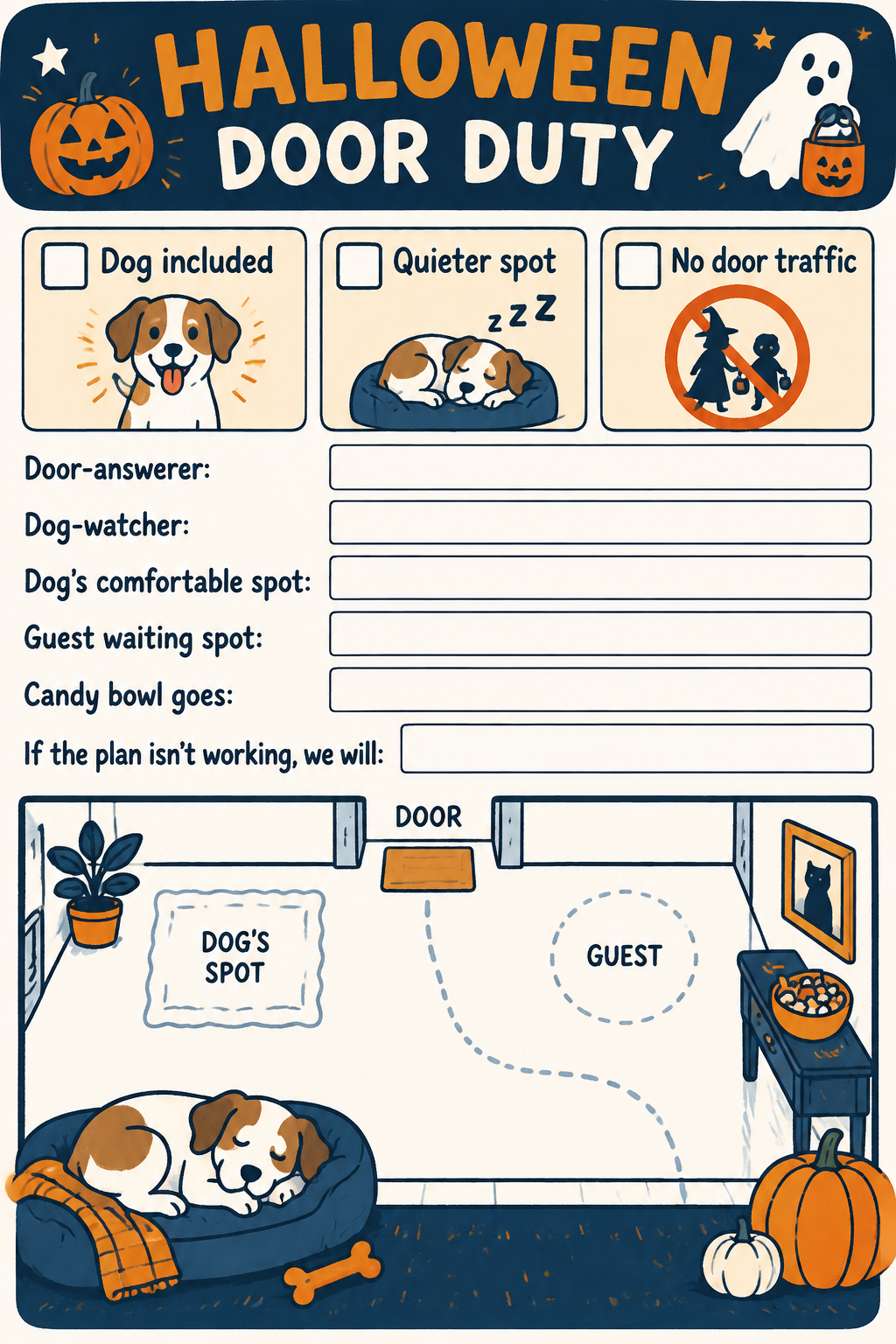
Copy or print this checklist, or fill it in on your phone. The point is to make the choices before the doorbell starts auditioning for a percussion section.
HALLOWEEN DOOR DUTY
- □ Our plan: Dog included with a boundary / dog in a quieter spot / no door traffic
- □ Door-answerer: __________________________________________
- □ Dog-watcher: ______________________________________________
- □ Guest guide, if needed: _____________________________________
- □ Dog’s comfortable spot: ____________________________________
- □ How the dog stays separate from the doorway: ________________
- □ Guest route and waiting spot: ______________________________
- □ Where the candy bowl goes: ________________________________
- □ Who knows where the existing gate or closed-door option is: _____
- □ If the plan isn’t working, we will: __________________________
Quick route sketch:
Dog’s spot: ____________________
Guest waiting spot: ____________________
Door-answerer: ____________________
Route to keep clear: ____________________
Run the evening in the same simple order
- Before answering: The dog-watcher guides the dog to the planned spot, or checks that the agreed boundary is in place. If your dog is meant to be part of the activity, confirm that the route to the open door is still blocked.
- At the door: The door-answerer handles the knock and candy. Guests wait for that person rather than opening the door themselves or reaching toward the dog. Keep the exchange as brief as suits your setup.
- Between visits: The dog-watcher checks the dog and the arrangement. Don’t assume a spot that worked earlier will suit the dog for the whole evening; pay attention to what you’re seeing and hearing.
- If people arrive at once: One person manages the queue while the other stays responsible for the dog. If there’s no second person, pause or reduce the door traffic rather than trying to do both jobs with one pair of hands.
Keep candy and wrappers out of reach after the handoff, too. If your dog does get into Halloween candy, keep the wrapper and contact your vet promptly.
Plan B: make the evening quieter
If the setup isn’t working—perhaps the dog can’t settle, the traffic is too much, or the household can’t keep the route clear—reduce the visitors or noise exposure and switch to your quieter option. That could mean keeping the dog in a familiar space with a closed door, if they’re comfortable there, or stopping the door-answering routine altogether. It’s not a training failure. It’s a change of plan.
If your dog becomes very distressed, or their behavior raises a safety concern for them or other people, don’t try to solve it with a brand-new training strategy in the middle of Halloween. Get individualized advice from a qualified professional who can consider your dog and home.
Once the jobs are assigned, the route is clear and the dog has a suitable alternative, the whole operation becomes pleasantly boring. The door-answerer has the bowl. The dog has their spot. The masked superhero gets their treat. And your household’s Director of Knock Investigations can clock out whenever they’re ready. ❤️


Leave a Reply
You must be logged in to post a comment.