

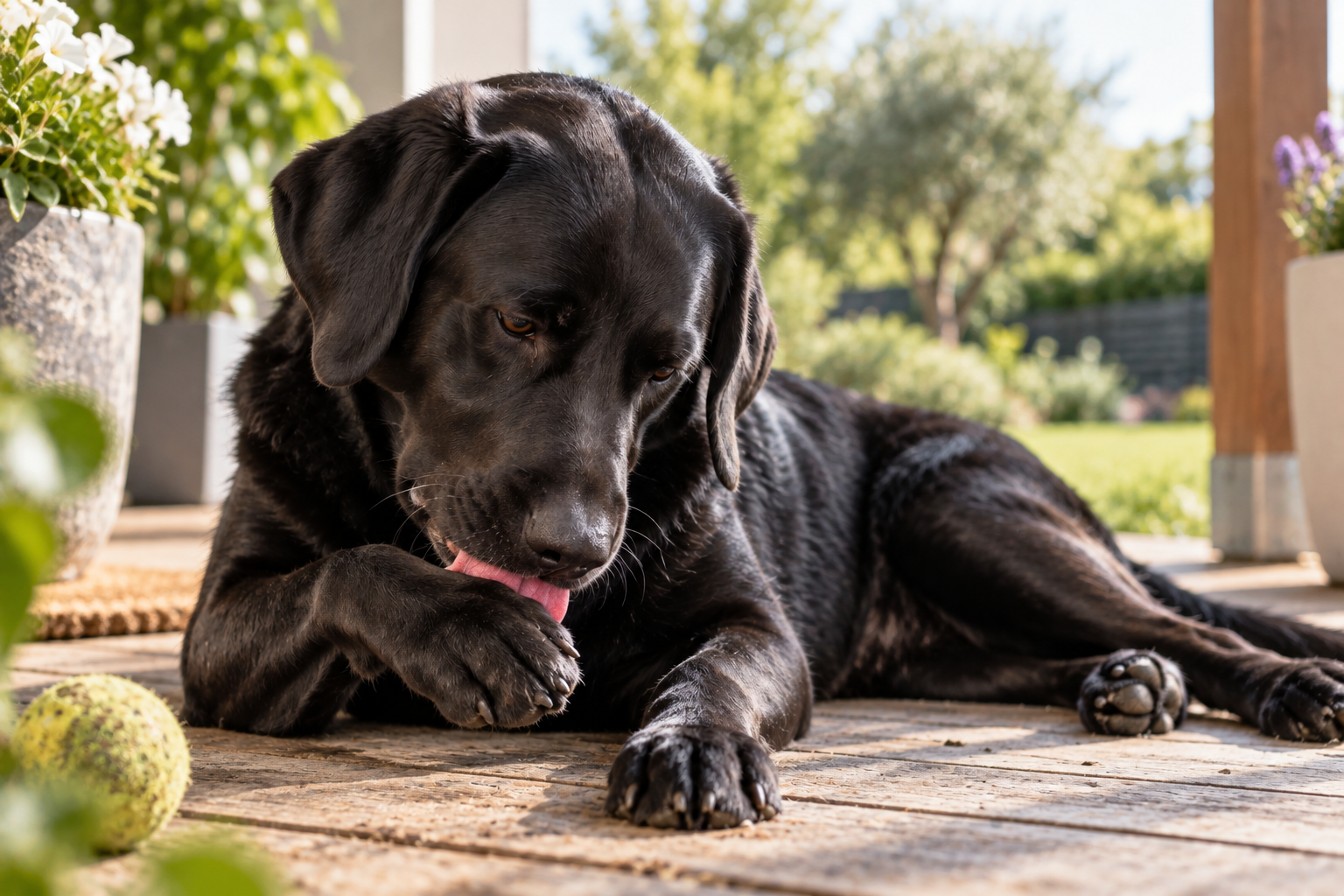
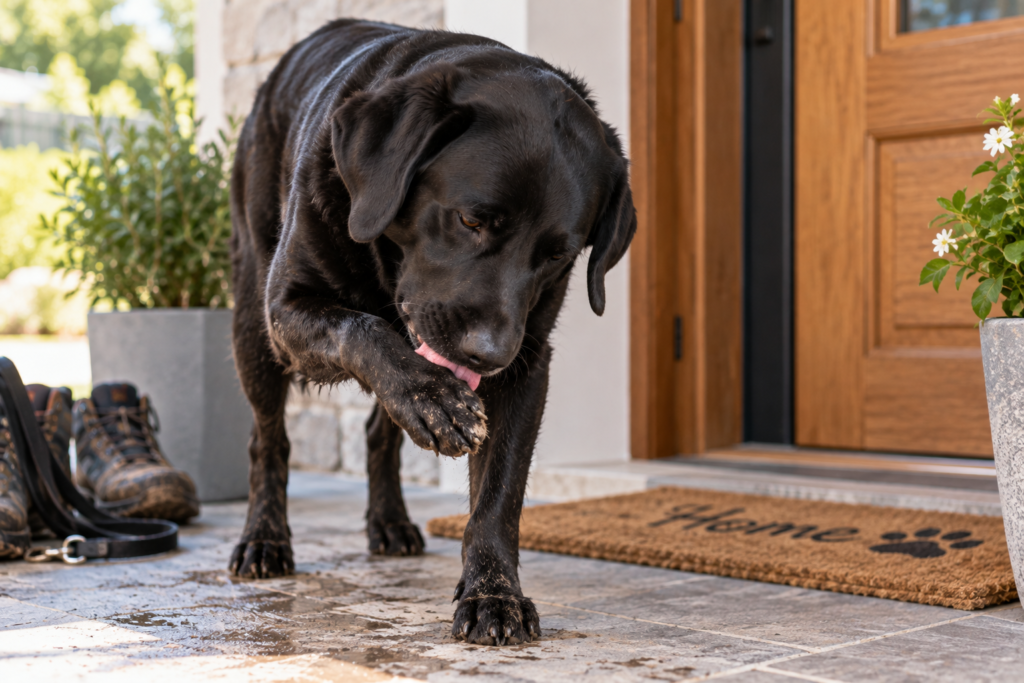
Your dog gives their paw a quick lick after a walk. Probably nothing unusual.
Twenty minutes later, they’re still licking the same spot.
That’s a different question.
Dogs lick their paws for all sorts of reasons, and some of them are completely normal. A little grooming after being outside may simply be your dog cleaning away dirt or something that feels uncomfortable between their toes.
But frequent, intense, or persistent paw licking can also be a sign that something is bothering them — from a tiny splinter to itchy skin, allergies, infection, pain, or, in some cases, a behavioral issue.
The important part isn’t simply whether your dog licks their paws.
It’s how often they do it, which paws they’re licking, and what else is happening at the same time.
Is It Normal for Dogs to Lick Their Paws?
Yes. To a point.
Dogs naturally use their mouths as part of grooming, and an occasional paw-licking session isn’t automatically a reason for concern.
You might notice your dog licking their paws after a walk, after playing outside, or while settling down to rest. If the licking is brief, occasional, and the paws look healthy, there may be nothing wrong at all.
What matters is when the pattern changes.
A dog who suddenly becomes fascinated with one paw, repeatedly returns to the same spot, or spends long periods licking or chewing deserves a closer look.
That’s where a simple observation can become surprisingly useful.
One Paw or Several? Start There
Before trying to work out why your dog is licking, look at where they’re licking.
If your dog suddenly focuses on one paw, think local first.
There could be a small cut, a thorn or splinter, an insect sting, a damaged nail, irritation between the toes, or something else making that particular paw uncomfortable. Pain elsewhere in the paw or leg can sometimes lead to licking too.
If your dog is licking several paws, particularly if the behavior keeps returning, the picture can be different. More widespread itching or skin irritation — including allergies, parasites, or dermatological problems — becomes more relevant.
It’s not a diagnostic test. Dogs don’t always follow neat rules.
But it’s a useful first clue.
ONE PAW
Think local first
Small injury · foreign object · damaged nail · pain
SEVERAL PAWS
Think broader irritation
Itching · allergies · parasites · skin problems
It’s a clue, not a diagnosis.
Take a Closer Look at the Paw
If your dog is comfortable with having their paws handled, gently inspect the one they’re licking.
Look at the pads, nails, between the toes, and around the edges of the paw.
You’re looking for things such as:
- a small cut or abrasion;
- a thorn, splinter, burr, or other foreign material;
- a cracked or damaged nail;
- swelling;
- redness;
- irritated skin between the toes;
- discharge or an unusual smell.
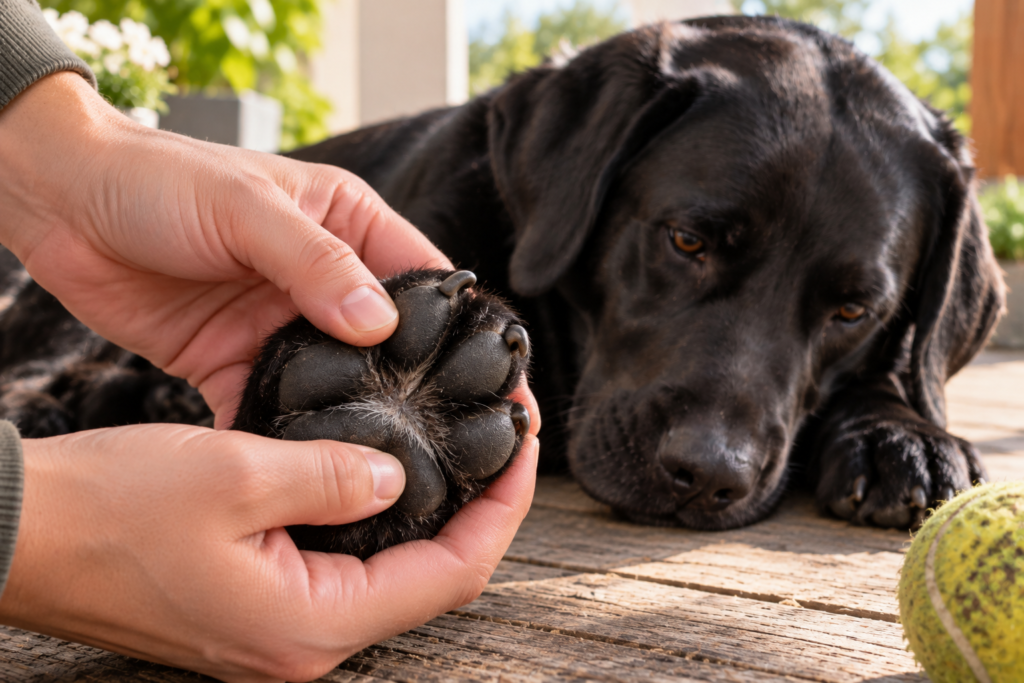
Don’t dig into the skin or attempt to remove something deeply embedded. And if touching the paw is clearly painful for your dog, that’s useful information in itself.
Sometimes the explanation really is something simple.
But sometimes the paw looks perfectly normal.
That’s when we need to look beyond the paw itself.
Itchy Paws Can Have Several Causes
Veterinarians use the term pruritus for itching, and itching is a symptom rather than a diagnosis.
That’s an important distinction.
A dog can have itchy paws because of parasites, infection, environmental irritation, allergies, or other skin conditions. The licking is the dog’s response to the discomfort — it doesn’t tell us exactly what caused it.
This is also where one of the most common assumptions about paw licking appears.
Does Paw Licking Mean My Dog Has Allergies?
Not necessarily.
Allergies absolutely can cause itchy paws, and dogs with allergic skin disease may lick, chew, or nibble at them repeatedly. Other areas — including the ears, face, legs, and belly — may also be affected.
But paw licking alone isn’t enough to diagnose an allergy.
Environmental allergens, flea allergy, food-related reactions, infections, parasites, and several other problems can produce overlapping signs.
So if your dog’s paws are persistently itchy, the useful question isn’t:
“Which allergy does my dog have?”
It’s:
“What’s causing the itching?”
That difference can save you from chasing the wrong solution.
Sometimes the Environment Is the Irritant
Your dog’s paws spend a lot of time in direct contact with the world.
Grass. Mud. Sand. Pavement. Plants. Cleaning products. Whatever was recently applied to that immaculate lawn down the street.
Something picked up during a walk may irritate the paws even when there isn’t an obvious injury.
Season can matter too. If the licking appears or becomes worse at particular times of year, that’s another pattern worth noting.
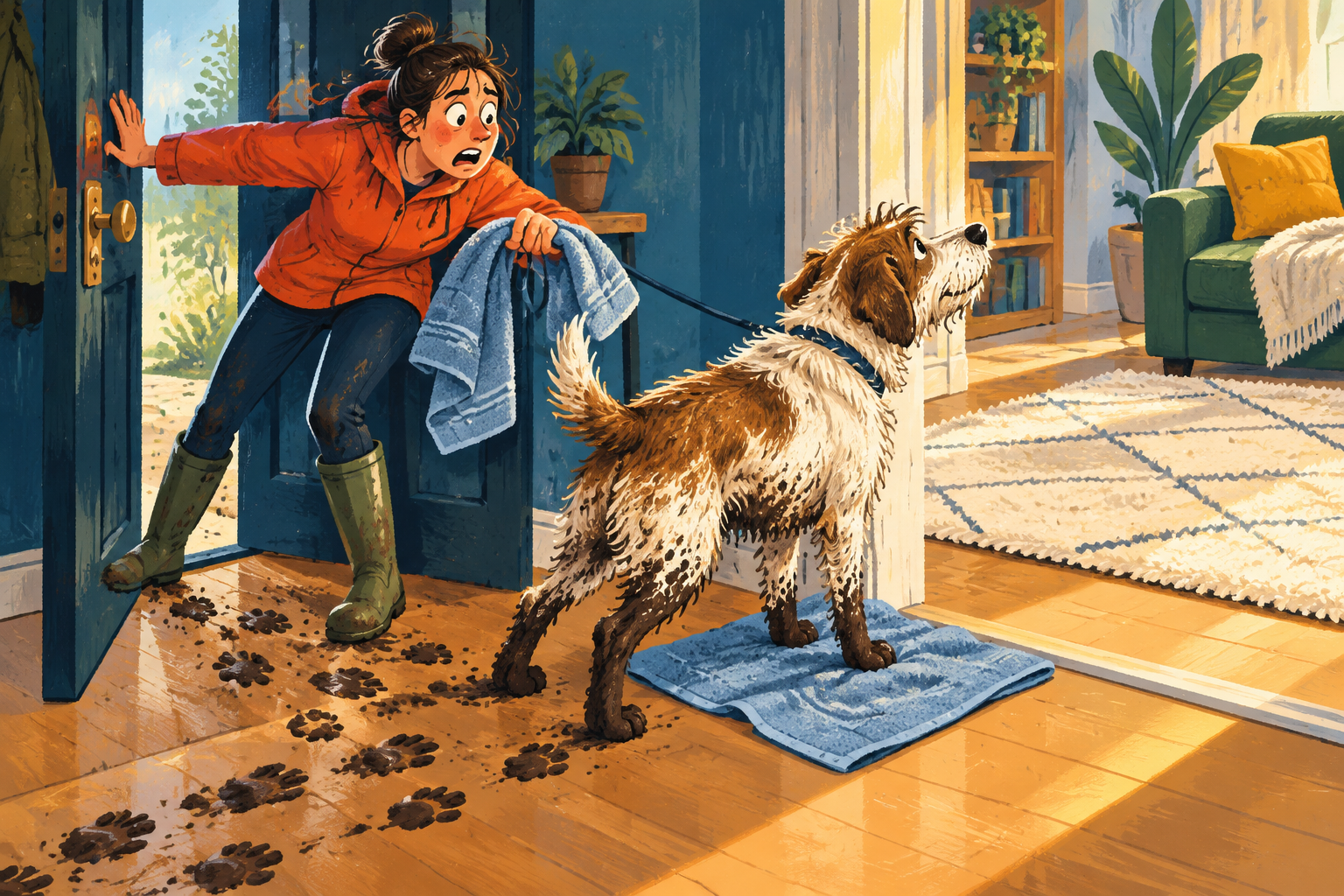
Checking and gently cleaning dirty paws after walks can therefore be sensible basic care, particularly if they’ve been through mud or something potentially irritating.
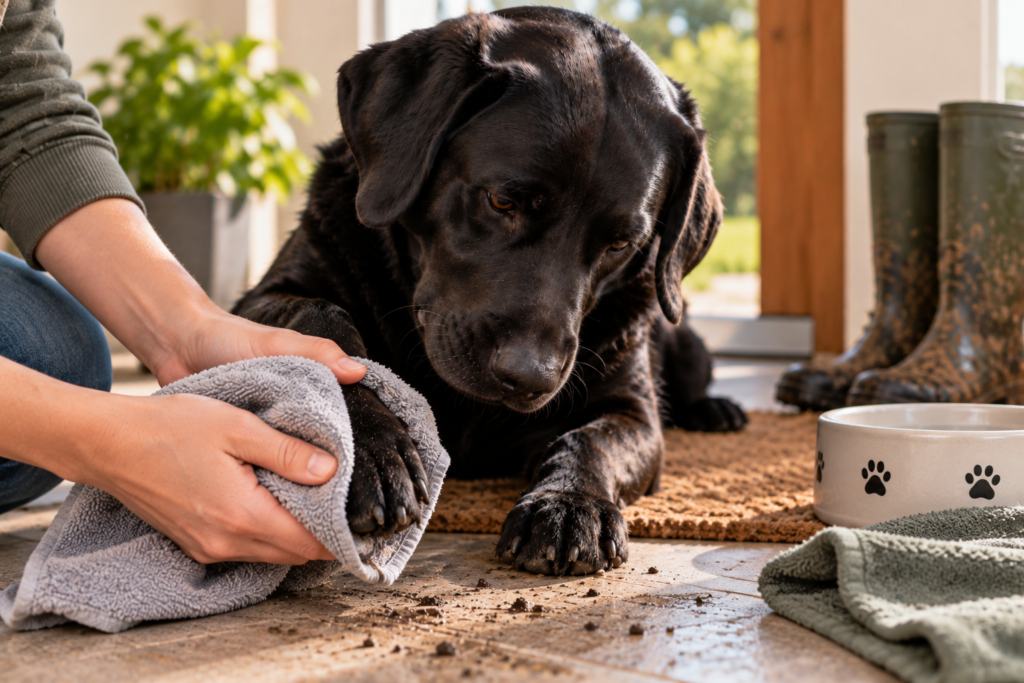
But persistent irritation shouldn’t simply be washed away and forgotten.
If the licking keeps returning, there’s probably still a reason for it.
Licking Can Make an Irritated Paw Worse
Here’s the annoying part.
Something makes the paw itchy.
Your dog licks because licking gives temporary relief.
But repeated licking keeps the skin moist and can further irritate or damage it. Inflamed skin can also become more vulnerable to secondary bacterial or yeast infections.
Now the paw feels even worse.
So the dog licks again.
ITCH → LICK → IRRITATION
↓
MORE LICKING → MORE IRRITATION
That’s why persistent paw licking is worth paying attention to even when the original trigger seemed minor.
Could It Be an Infection?
It could.
Bacterial and yeast infections can affect irritated skin, including the skin around and between a dog’s toes.
You may notice redness, swelling, discharge, an unusual odor, changes in the skin, or increasing discomfort — although appearance alone isn’t enough to identify exactly what kind of infection is present.
And there’s another complication: infection may not have been the original problem.
An underlying allergy or other source of inflammation can make the skin more vulnerable, meaning treating only the secondary problem may not address why it happened in the first place.
That’s another reason recurring paw problems deserve veterinary investigation rather than repeated guesswork at home.
Paw Licking Can Also Be About Pain
Not every dog licks because they’re itchy.
Dogs may lick an area that hurts.
A damaged nail or obvious paw injury is relatively easy to connect with licking. Other sources of discomfort can be much less obvious.
If the behavior begins suddenly — especially if your dog is favoring a paw, limping, reluctant to walk, or reacts when the area is touched — pain moves higher up the list of possibilities.
The paw doesn’t need to look dramatic for something to be wrong.
What About Boredom, Stress, or Anxiety?
They’re possible.
But they shouldn’t automatically be the first explanation.
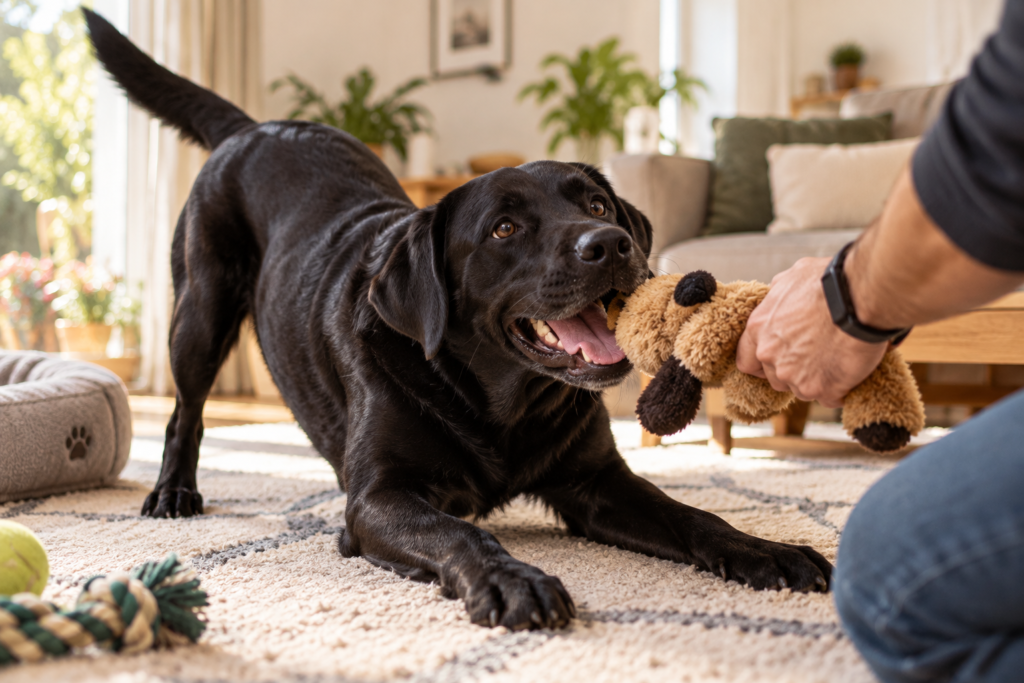
Some dogs can develop repetitive licking associated with stress, anxiety, boredom, or compulsive behavior. Licking may become a learned way of soothing themselves, particularly if it has been repeated for a long time.
The problem is that a dog with itchy or painful paws can look remarkably similar.
Calling persistent licking “anxiety” before considering physical causes risks missing the thing that’s actually making the dog uncomfortable.
That’s why behavioral explanations make more sense after medical causes have been considered or ruled out, especially when licking is intense or persistent.
If the paws are healthy and your veterinarian doesn’t find a physical explanation, then looking at when the behavior occurs becomes particularly useful.
Does it happen when your dog is left alone?
During stressful situations?
When they’re inactive for long periods?
At predictable times of day?
Patterns can tell you much more than the licking itself.
Should You Stop Your Dog From Licking Their Paws?
If it’s a quick bit of normal grooming, there’s usually nothing to stop.
Persistent licking is different.
Interrupting excessive licking may help protect already irritated skin, but simply preventing access to the paw doesn’t solve whatever made your dog want to lick it.
That’s the trap.
Stopping the licking and solving the cause are not the same thing.
Avoid applying human creams, medications, essential oils, or homemade treatments without veterinary guidance. Dogs can lick products from their paws, and something safe for human skin isn’t automatically safe for a dog to ingest or use on damaged skin.
Instead, start with observation.
PAW-LICKING CHECKLIST
Which paw? · How often? · For how long?
When did it begin? · What does the skin look like? · Has anything else changed?
A photograph taken when you first notice the problem can also be surprisingly useful if the appearance changes before a veterinary appointment.
When Should You Call Your Vet?
Occasional licking with otherwise healthy-looking paws doesn’t usually require an emergency appointment.
But contact your veterinarian if the licking is persistent, keeps returning, is becoming more intense, or you notice other signs that something is wrong.
Seek veterinary attention sooner if you notice:
- bleeding or an open wound;
- significant swelling;
- pus or other discharge;
- marked redness or damaged skin;
- a broken or badly injured nail;
- limping or reluctance to put weight on the paw;
- obvious pain when the paw is touched;
- a foreign object you can’t safely remove.
And even without dramatic signs, recurring paw licking is worth discussing if it has become part of your dog’s daily routine.
Dogs can’t tell us “this has been itching for three weeks.”
Sometimes repetition is how they tell us instead.
The Biscuit Theory Takeaway
A dog licking their paws isn’t automatically a dog with a problem.
Sometimes they’re just cleaning themselves.
The clue is the pattern.
A quick lick after a muddy walk is very different from repeatedly chewing the same paw every evening. One irritated paw tells a different story from four persistently itchy ones.
So rather than trying to diagnose your dog from the licking alone, pay attention to the context:
how often, how intensely, where, and what else has changed.
Because the licking isn’t always the problem.
Sometimes it’s the clue.
Frequently Asked Questions
Why does my dog lick their paws at night?
Some paw licking may simply become more noticeable when your dog settles down and there are fewer distractions. But repeated nighttime licking can also reflect itching, discomfort, or a learned behavior. If it happens frequently, look for patterns and inspect the paws rather than assuming the time of day explains it.
Why does my dog lick only one paw?
Sudden licking focused on one paw can point toward a localized problem such as a small injury, damaged nail, insect sting, foreign material, or pain. Gently inspect the paw if your dog allows it, and contact your veterinarian if the licking persists or you notice pain, swelling, limping, or injury.
Why does my dog lick all four paws?
Licking several paws may be more consistent with widespread itching or irritation than a single localized injury. Allergies are one possibility, but parasites, infections, and other skin conditions can cause similar signs, so persistent licking deserves proper investigation.
Can paw licking be caused by anxiety?
Yes, repetitive licking can sometimes be associated with stress, anxiety, boredom, or compulsive behavior. However, physical causes such as itching and pain should be considered first. Behavioral explanations are much more useful once medical causes have been assessed.
Should I let my dog keep licking a sore paw?
Persistent licking can further irritate already damaged skin and may contribute to a cycle of inflammation and continued licking. Preventing excessive licking can protect the area temporarily, but the underlying reason for the soreness still needs to be addressed.
Leave a Reply
You must be logged in to post a comment.