


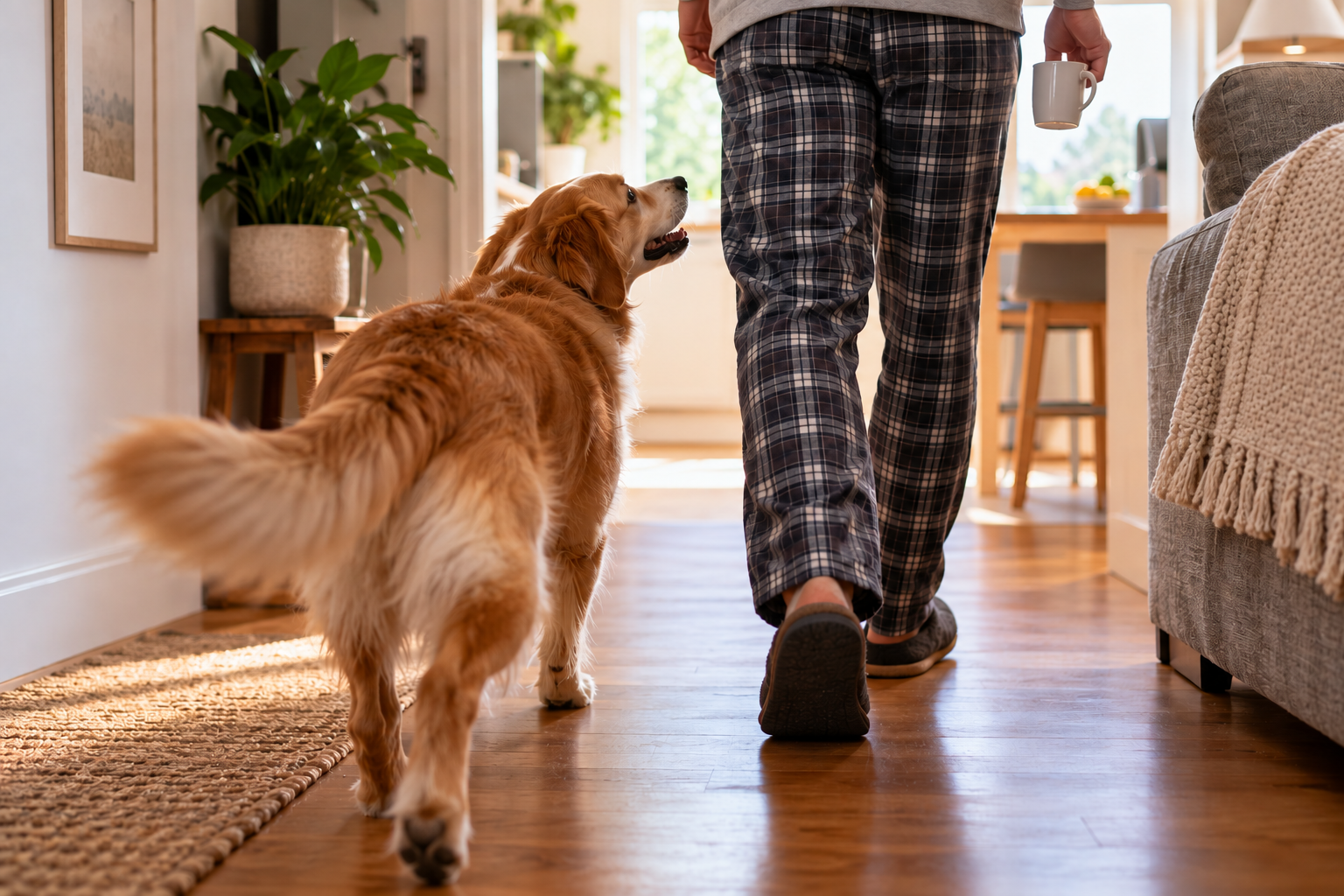
You get up from the sofa. Your dog gets up too.
You walk to the kitchen. There he is.
You go upstairs. Apparently, so does he.
And when you finally head to the bathroom and close the door, there may be a nose waiting suspiciously close to the other side.
If this sounds familiar, congratulations: you may have acquired a four-legged shadow.
But why does your dog follow you everywhere?
Usually, the answer is reassuringly simple. Dogs may follow the people they live with because they enjoy being near them, because they’ve learned that following leads to interesting things, because it has become part of their daily routine — or some combination of all three.
And sometimes?
You’re simply the most interesting thing happening in the house.
Why Is My Dog Always Following Me?
There isn’t one universal explanation.
Dogs are individuals, and the reason one dog follows a person from room to room may be quite different from another’s.
But there are several good places to start.
1. Your dog genuinely likes being near you
This one shouldn’t be overlooked just because it sounds obvious.
Dogs can form meaningful attachment relationships with their human caregivers. Research has found that dogs seek proximity and contact with familiar caregivers and can behave differently when exploring in their presence.
So sometimes your dog’s reasoning may be remarkably uncomplicated:
You’re here. Your dog likes being with you. So your dog is here too.
Not everything needs a more dramatic explanation.
2. Following you has become part of the routine
Dogs are exceptionally good at noticing patterns in our lives.
Think about how predictable you actually are from your dog’s perspective.
You get up in the morning and breakfast happens.
You pick up a particular pair of shoes and a walk might happen.
You enter the kitchen and food occasionally falls from the heavens.
You sit in a certain chair and there’s a reasonable chance of scratches.
You walk toward the front door and suddenly things become very interesting.
Over time, following you can simply become worthwhile.
Even attention can reinforce the behaviour. If your dog follows you and regularly receives conversation, touching, play or something else they value, you’ve given them another perfectly sensible reason to try it again.
You may therefore have helped create your little shadow without ever deliberately teaching a thing.
3. Something interesting might happen
Imagine living with someone who controls practically every exciting event in your day.
Food?
Human.
Walk?
Human.
Garden door?
Human.
Car ride?
Human.
Mystery package arriving at the front door that must immediately undergo a complete forensic sniffing examination?
Also human.
Following you can give your dog information about what is about to happen.
And because occasionally something really good happens, checking what you’re doing can be worth the effort.
Your trip to the kitchen might produce absolutely nothing 19 times.
But number 20?
Cheese.
And now we have a compelling reason to continue monitoring the kitchen situation.
4. Some dogs simply want more proximity than others
Dogs differ enormously in how much physical closeness and contact they seek.
One might happily sleep downstairs while you work upstairs. Another wants to occupy the approximately six centimetres between your feet and your office chair.
That’s why comparing your dog with somebody else’s isn’t always particularly useful.
Your friend’s dog spending the afternoon alone in another room doesn’t necessarily mean yours should.
And yours following you around doesn’t automatically mean something is wrong.
Is It Normal for My Dog to Follow Me Everywhere?
Often, yes.
Being interested in where you are and choosing to stay nearby can be perfectly normal canine behaviour.
Following family members around the house, by itself, isn’t enough to tell us that a dog has separation anxiety.
That distinction matters.
A dog can follow you into the kitchen, supervise your attempt to make coffee, accompany you back to the sofa and then spend two peaceful hours asleep while you’re out.
Another dog might barely follow you around the house but become distressed shortly after you leave.
What happens when you’re apart can tell us more than the simple fact that your dog follows you when you’re together.
Did I Accidentally Teach My Dog to Follow Me?
Quite possibly.
And you didn’t need a training session to do it.
Learning happens during ordinary life.
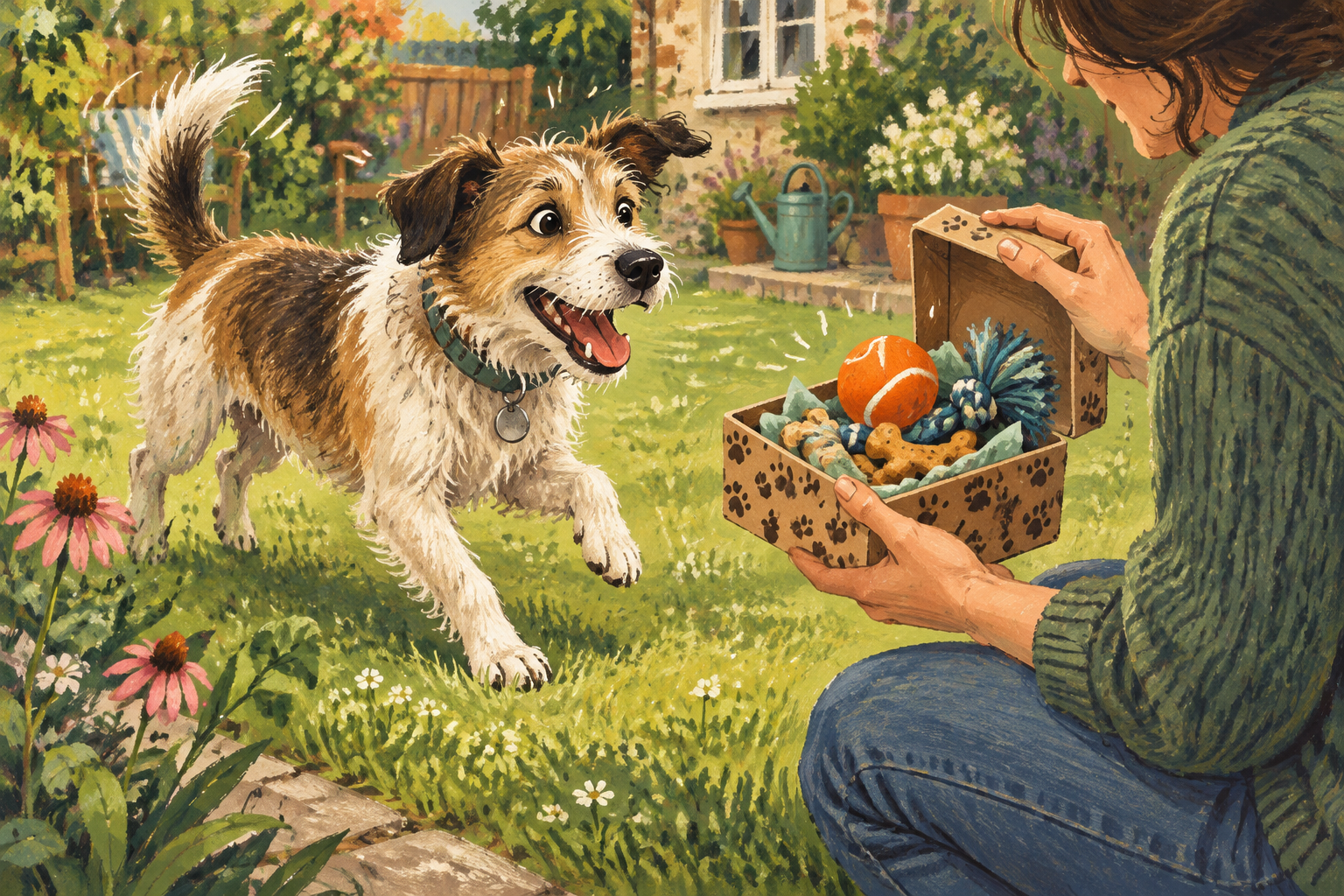
Suppose your dog follows you into the kitchen and occasionally receives a little piece of food.
Or follows you to the sofa and gets cuddles.
Or follows you toward the door and discovers it’s walk time.
The behaviour keeps having good outcomes.
From your dog’s point of view, continuing to follow you makes perfect sense.
This doesn’t mean you’ve done anything wrong, and it certainly doesn’t mean you need to start ignoring your dog every time they approach you.
It simply explains why a behaviour that might initially have been casual can become a very established habit.
Dogs are learning from us even when we don’t realise we’re teaching.
Why Does My Dog Follow Me to the Bathroom?
Ah.
The final frontier of human privacy.
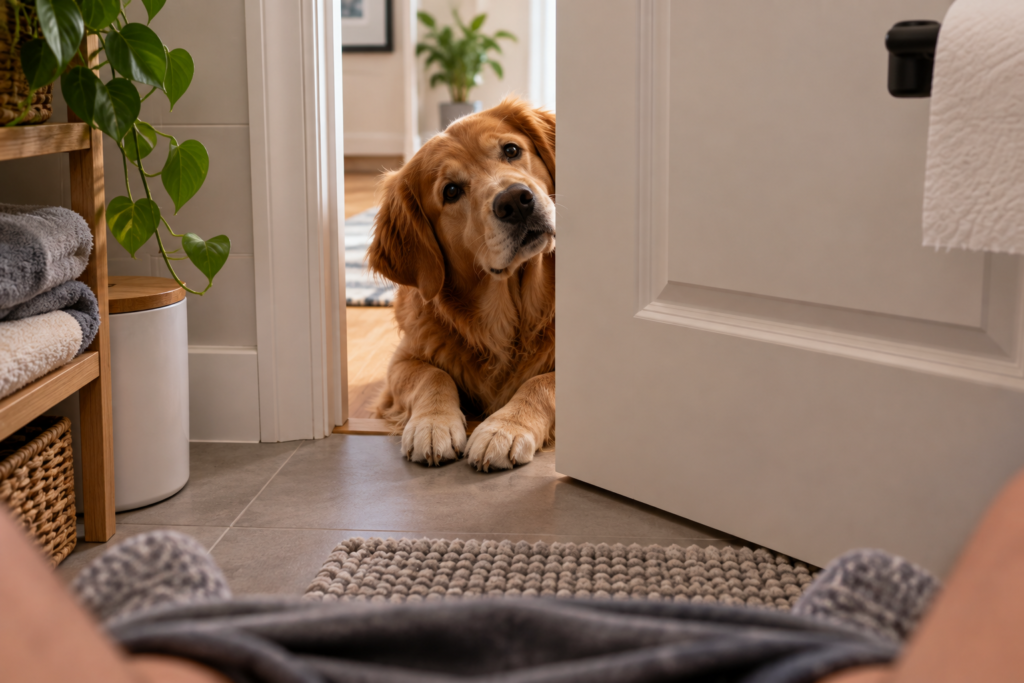
You’ve closed the laptop. You’ve left the television behind. There are no treats involved.
Surely this journey can be undertaken alone?
Your dog disagrees.
Following you to the bathroom doesn’t necessarily require a special explanation separate from following you anywhere else.
You moved.
Your dog noticed.
Your dog likes being near you, has developed the habit of following you, wants to know what’s happening — and apparently sees no reason why an arbitrary wooden door should suddenly terminate the arrangement.
Dogs also don’t share our cultural understanding that the bathroom is supposed to be private.
To your dog, you haven’t entered a sacred zone of solitude.
You just went into another room.
We humans are the weird ones who suddenly started making rules about it.
Is My Dog a “Velcro Dog”?
You may hear particularly clingy dogs described as Velcro dogs.
It’s a wonderfully descriptive nickname: wherever the human goes, the dog appears to remain firmly attached.
But “Velcro dog” isn’t a diagnosis.
It’s simply an informal way of describing a dog that prefers to stay particularly close to its person.
And this is where we need to resist making an easy leap:
Velcro dog does not automatically mean separation anxiety.
The more useful question isn’t only how close your dog wants to be while you’re home.
It’s also:
What happens when you’re gone?
Following You vs. Separation Anxiety
This is where our silly little shadow question becomes slightly more serious.
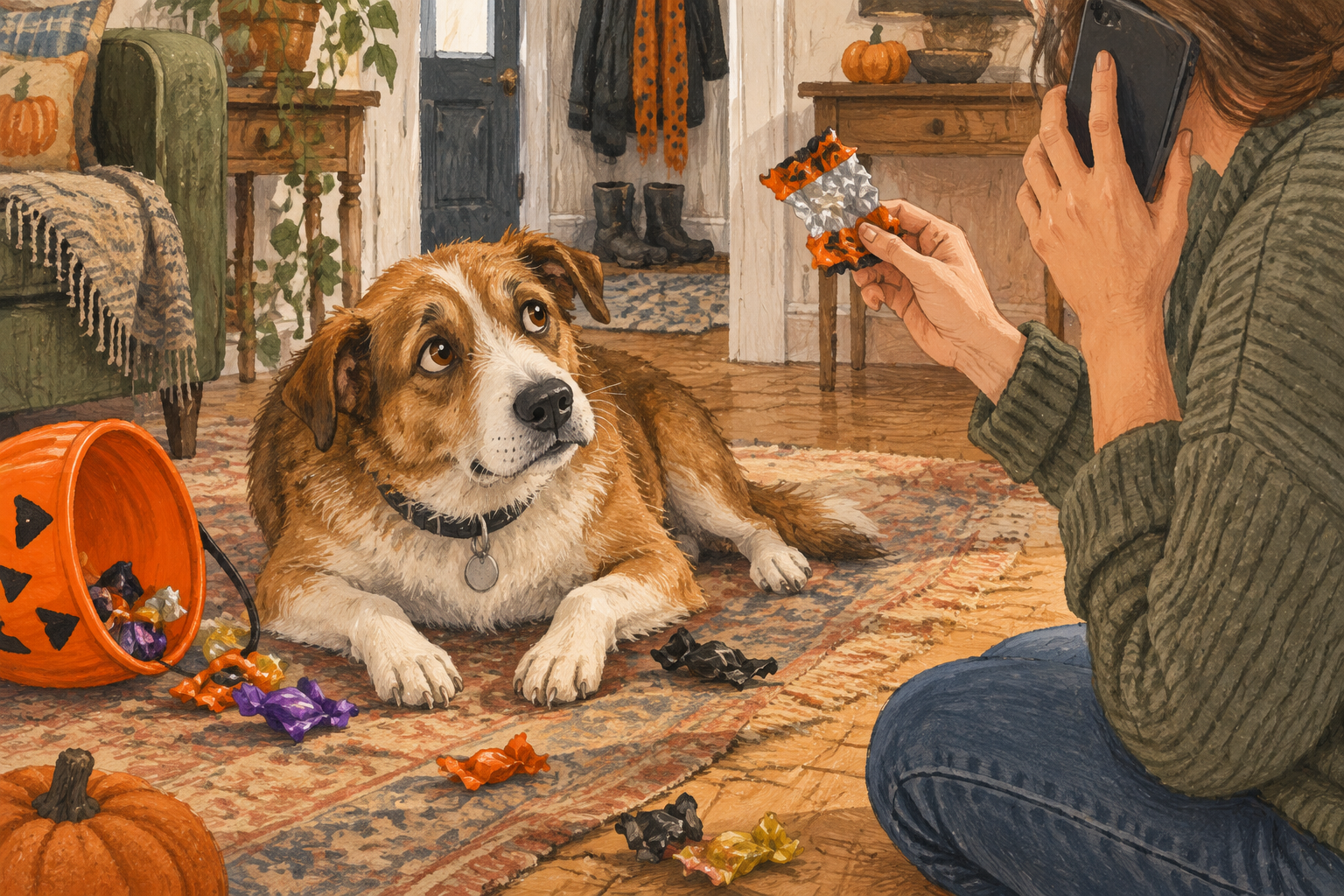
Dogs experiencing separation-related distress may show behaviours such as barking or howling, pacing, restlessness, destruction, house soiling, excessive salivation, difficulty settling or changes around eating while alone. Some dogs begin showing signs of anxiety while their person is preparing to leave.
Those behaviours are very different from simply wandering after you while you’re home.
And separation-related problems aren’t necessarily identical in every dog. Similar outward behaviours can have different causes, which is one reason not to diagnose a dog from one behaviour alone.
If you’re curious about what your dog actually does after you leave, recording them can be useful. Video may reveal behaviour that you would otherwise never see.
Your dog following you while you’re home is therefore one piece of information, not a diagnosis.
What If My Dog Suddenly Starts Following Me Everywhere?
This deserves more attention than a dog who has simply been your shadow for years.
Changes in behaviour matter.
A dog suddenly seeking much more proximity may be responding to a change in routine or environment, stress, fear or another change in how they’re feeling. Health-related changes can affect behaviour too, particularly as dogs get older.
That doesn’t mean a suddenly clingy dog is necessarily ill.
It means “this is new” is useful information.
If the change is pronounced or persistent, or comes with other changes in behaviour, appetite, movement, sleep, toileting or general wellbeing, it’s worth discussing with your veterinarian rather than trying to diagnose the reason from the following behaviour alone.
Should I Stop My Dog From Following Me?
Not simply because they follow you.
If your dog is relaxed, happy and able to cope when you’re apart, there may be no problem here that actually needs fixing.
You don’t have to turn normal companionship into a training project.
That said, being comfortable spending some time independently is a useful life skill. Dogs can benefit from learning that relaxing somewhere other than directly beside their person is perfectly safe and rewarding too.
The goal isn’t:
“My dog must stop wanting to be with me.”
It’s:
“My dog can enjoy being with me and still feel okay when I’m not there.”
Those are very different things.
So… Why Does Your Dog Follow You Everywhere?
Maybe being near you is simply where your dog prefers to be.
Maybe you’ve become associated with virtually everything good that happens during the day.
Maybe following you has become such a familiar routine that neither of you remembers when it started.
Maybe they’re curious.
Maybe they’re hoping you’re going to the kitchen.
And yes, occasionally there may be something more going on — particularly if the behaviour has suddenly changed or your dog becomes distressed when you’re apart.
But don’t diagnose a happy four-legged shadow just for being a shadow.
So the next time you stand up and hear those familiar footsteps behind you, you don’t necessarily need to wonder:
What’s wrong with my dog?
Sometimes a better question is:
Where did you think you were going without them?
Leave a Reply
You must be logged in to post a comment.