


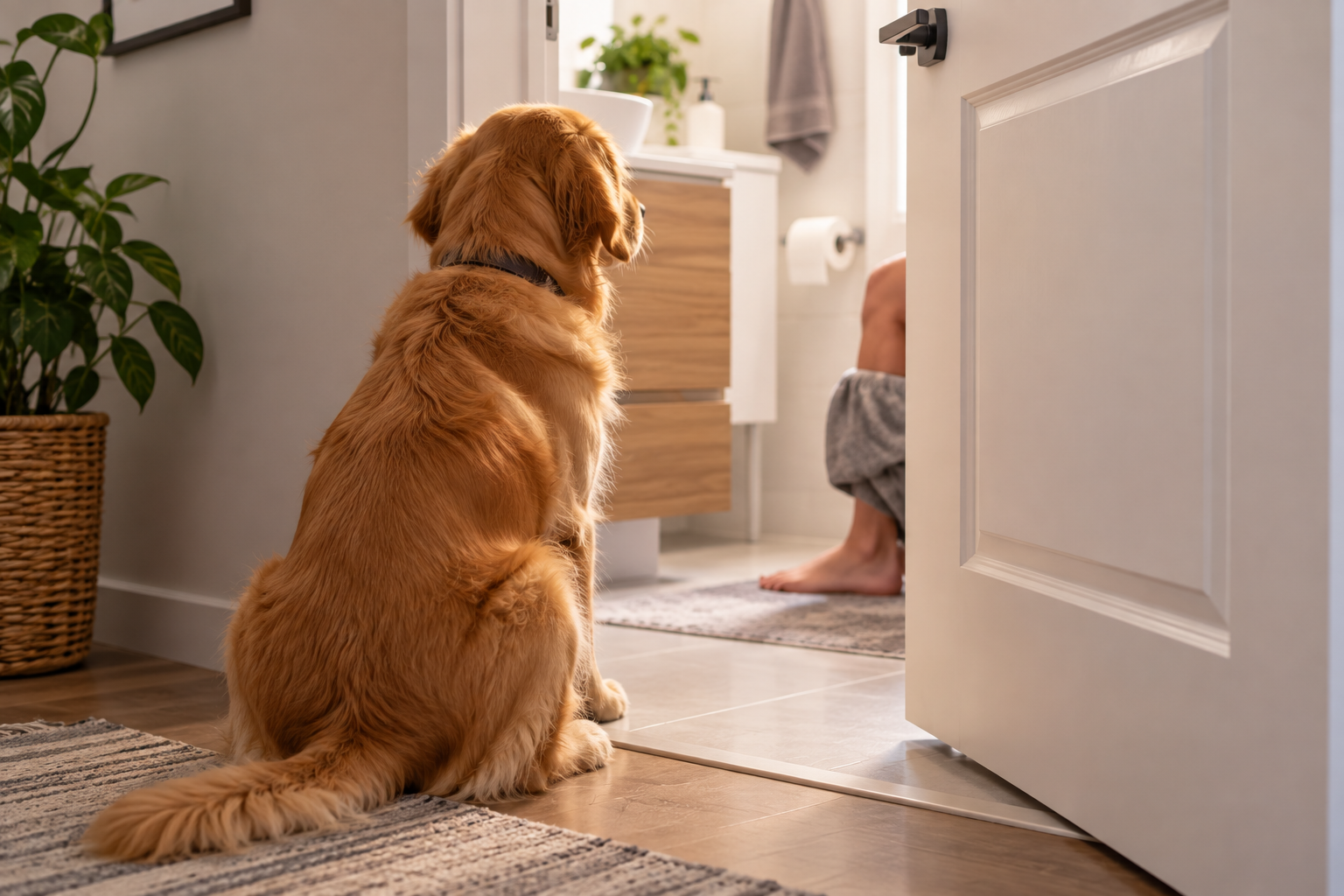
You get up, walk toward the bathroom, and before you can close the door, there they are.
Your dog.
Apparently, privacy was not included in the adoption agreement.
If your dog regularly follows you to the bathroom, the good news is that this behavior is usually nothing to worry about. Dogs form strong social bonds with their humans, and staying close to you can simply be part of that relationship. Curiosity, routine, and learned behavior can all play a role too.
But does following you to the bathroom mean your dog is overly attached to you? And could it be a sign of separation anxiety?
Usually, no.
Let’s look at why your dog insists on joining you — and when following you might actually be worth paying closer attention to.
Why Does My Dog Follow Me to the Bathroom?
There probably isn’t one universal reason.
Your dog may follow you because they enjoy being near you, want to know where you are going, or have simply learned that following you is part of the daily routine.
Dogs can form attachment relationships with their human caregivers and commonly seek proximity to them. So when you suddenly stand up and disappear into another room, following you isn’t particularly surprising.
The bathroom itself may not even be important.
From your dog’s perspective, you moved somewhere else.
And they came with you.
1. Your Dog Simply Likes Being Near You
Sometimes the simplest explanation is the best one.
Your dog may follow you because being close to you feels familiar, comfortable, and rewarding.
Research into dog-human attachment has shown that dogs can seek proximity and contact with their caregivers and use them as an important social presence.
That doesn’t mean every dog needs to be physically attached to their human at all times. Dogs have different personalities, experiences, routines, and relationships.
Some will happily sleep in another room.
Others apparently believe that a closed bathroom door is a serious violation of household policy.
Both can be perfectly normal.
2. They Want to Know Where You’re Going
Dogs pay remarkable attention to what happens around them.
You stand up.
You walk away.
A door opens.
Something might be happening.
For a curious dog, following you is an easy way to find out what.
This is especially likely if your dog tends to investigate other everyday activities too — following you into the kitchen, watching while you unpack groceries, or appearing the moment you open a cupboard.
The bathroom may simply be another destination on their daily tour of everything you do.
3. Following You Has Become Part of the Routine
Dogs are very good at learning patterns.
If you follow roughly the same routines every day, your dog can begin anticipating what happens next.
Perhaps you wake up, go to the bathroom, get dressed, and then take your dog outside.
Or maybe bathroom time happens shortly before breakfast, a walk, bedtime, or another predictable event.
Over time, following you may simply become part of that sequence.
Your dog doesn’t need to understand what a bathroom is.
They only need to learn:
When my human goes there, I usually go too.
4. Following You May Have Been Rewarded
Not every reward comes from a treat bag.
Attention can be rewarding too.
If your dog follows you into the bathroom and you talk to them, pet them, laugh at them, or otherwise interact with them, following you may become even more worthwhile.
That doesn’t mean you have accidentally “trained your dog incorrectly.”
It simply means behavior can be reinforced by what happens after it.
And sometimes the reward is nothing more complicated than getting to stay beside their favorite person.
Why the Bathroom Specifically?
This is where humans tend to make the question more mysterious than it needs to be.
Your dog probably doesn’t have a special psychological fascination with bathrooms.
The important event may simply be that you went somewhere.
Bathrooms also have doors, which makes the situation more noticeable. If your dog follows you into the living room, you may barely register it. When they push their nose through a bathroom door before you can close it, you definitely notice.
There may also be interesting smells, sounds, objects, water, towels, bins, or other things worth investigating.
But there is no need to invent an elaborate bathroom-specific instinct when ordinary social behavior, curiosity, and routine can explain much of what we see.
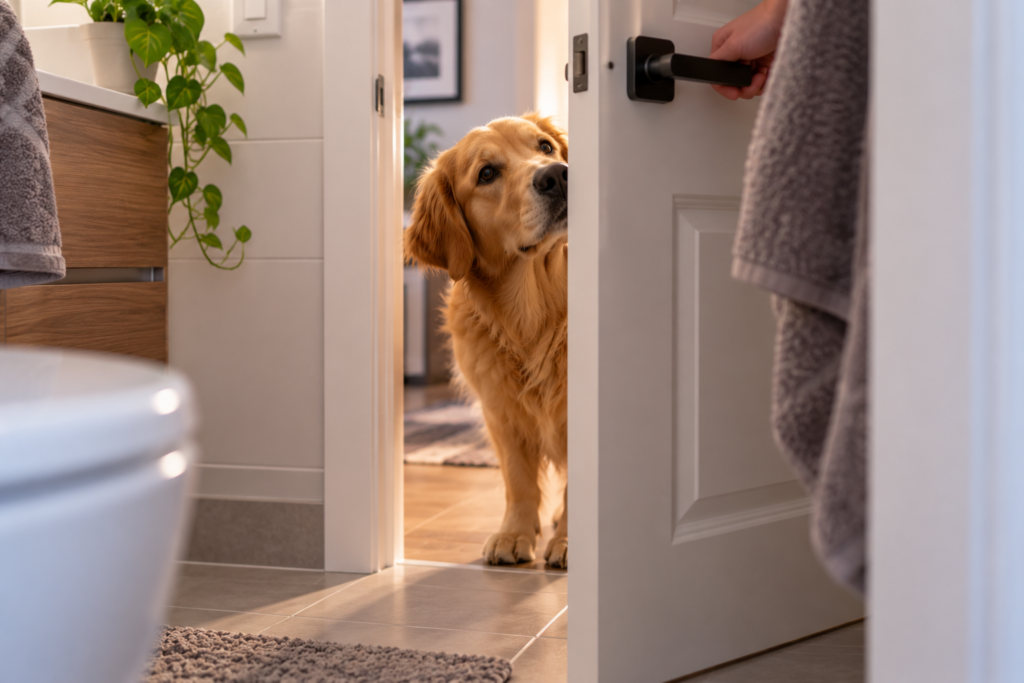
Does My Dog Follow Me Because They Love Me?
Possibly — but we should be careful about translating every dog behavior directly into a human emotion.
A dog choosing to spend time near you can certainly be consistent with a strong social bond.
Dogs form meaningful attachment relationships with their caregivers, and research has documented behaviors such as proximity-seeking and preference for the owner over unfamiliar people.
So yes, your relationship probably matters.
But “my dog follows me to the bathroom because they love me” is better understood as an affectionate interpretation than a precise scientific explanation.
Sometimes your dog loves you.
Sometimes your dog is curious.
Sometimes both things are true.
Does Following Me to the Bathroom Mean Separation Anxiety?
Not by itself.
This distinction matters.
A dog that follows you around the house is not automatically a dog with separation anxiety.
Separation-related problems are concerned with what happens when a dog is actually separated from the people they are attached to. The important question is therefore not simply:
Does my dog follow me?
It is:
What happens when my dog cannot follow me or when I actually leave?
Signs of separation-related distress can include behaviors such as persistent vocalization, destructive behavior, attempts to escape, restlessness, or other signs of distress associated with being left alone.
Following you to the bathroom without those problems tells us very little on its own.
A relaxed dog who follows you inside, lies on the floor for a minute, and then carries on with their day is very different from a dog who panics whenever a door separates you.
Context matters.
When Is Bathroom Following Completely Normal?
In most cases, you probably don’t need to do anything.
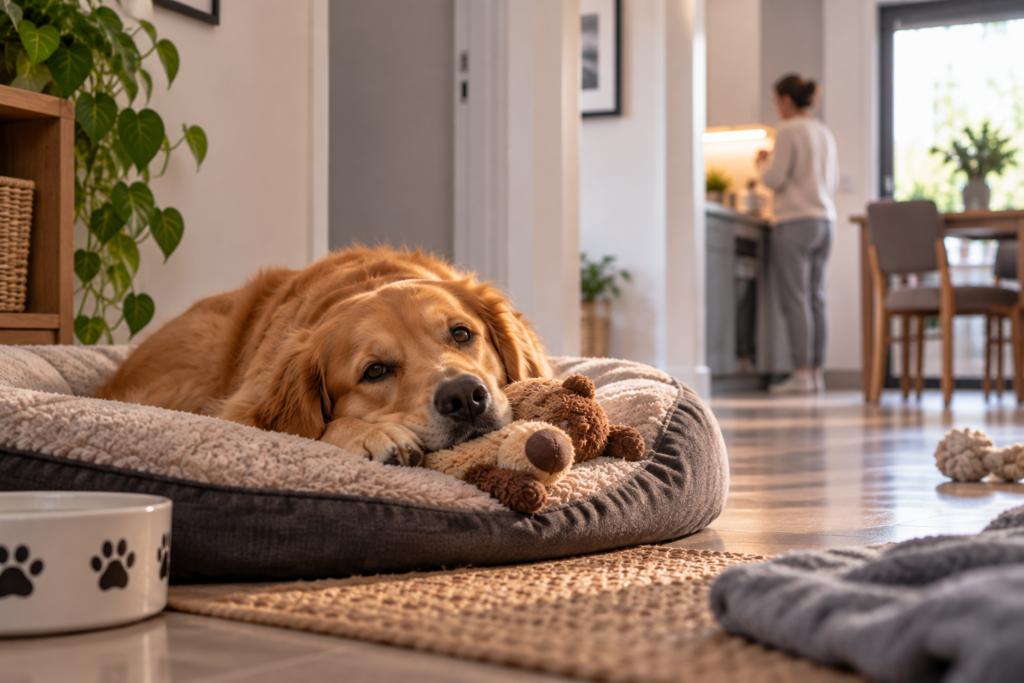
Bathroom following is much less concerning when your dog:
- looks relaxed while following you;
- can settle elsewhere in the house;
- is comfortable when a door occasionally separates you;
- can rest without constantly checking where you are;
- shows no obvious distress when left alone for appropriate periods;
- continues eating, playing, sleeping, and behaving normally.
If that describes your dog, you may simply have a four-legged bathroom companion.
Whether you appreciate the company is another matter.
When Should You Pay More Attention?
Following becomes more interesting when it is part of a larger change or pattern.
For example, pay attention if your dog suddenly becomes much more dependent on your presence than usual, particularly if the change is accompanied by other behavioral or physical changes.
You should also look more closely if separation causes obvious distress.
That might include persistent barking or howling, frantic attempts to follow or escape, destructive behavior associated with departures, inability to settle, or other significant changes when your dog is left alone.
The key point is that the bathroom following itself is not the diagnosis.
It is the wider pattern that matters.
If the behavior is new, intense, or accompanied by signs that concern you, speaking with your veterinarian is a sensible first step. Medical problems can sometimes contribute to behavioral changes, and a veterinarian can help determine whether further behavioral support is appropriate.
Should I Stop My Dog From Following Me to the Bathroom?
Not necessarily.
If the behavior doesn’t bother you and your dog is otherwise comfortable and independent when needed, there is usually no reason to turn bathroom access into a training problem.
But you are also allowed to want privacy.
Teaching your dog that they can relax somewhere else while you disappear for a few minutes is perfectly reasonable.
The goal doesn’t need to be:
My dog must never follow me.
A healthier goal is:
My dog can follow me sometimes, but they are also comfortable when they cannot.
How Can I Encourage My Dog to Be More Independent?
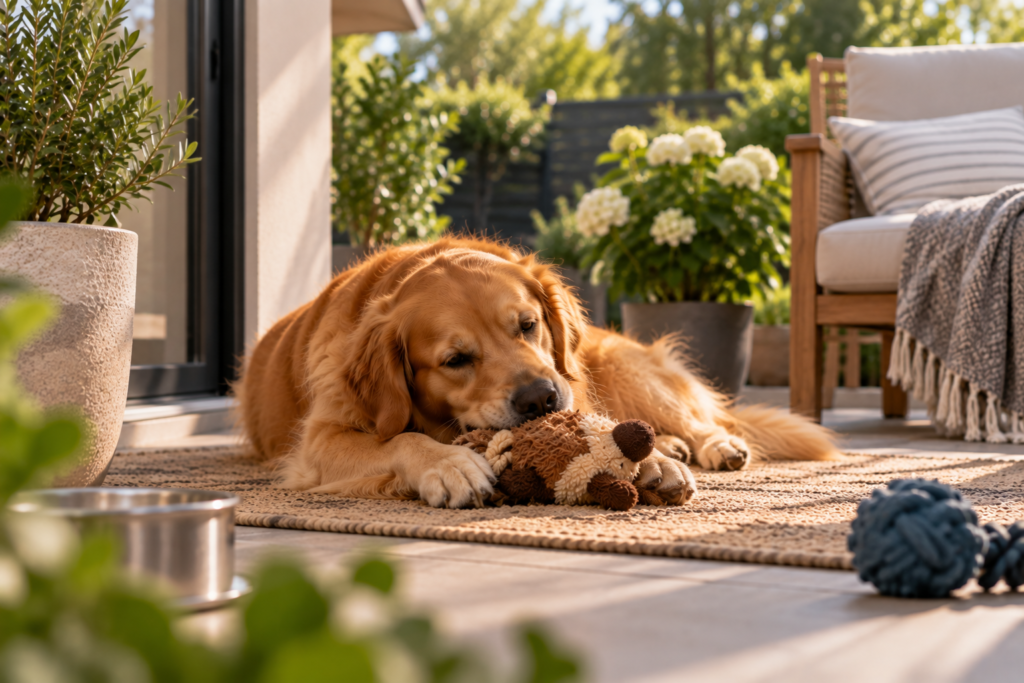
Independence doesn’t require rejecting your dog or deliberately withholding affection.
Instead, make being away from you an ordinary and comfortable part of life.
Encourage your dog to settle on their bed or another comfortable spot while you move around the house. Give them opportunities to enjoy safe activities independently. Practice brief, low-pressure periods where you move into another room and return without turning the event into something dramatic.
Most importantly, work at a level your dog is comfortable with.
If closing a door immediately causes genuine distress, repeatedly forcing longer separations is not simply “teaching independence.” A dog showing significant separation-related distress may need an individual plan developed with appropriate professional help.
For a relaxed bathroom shadow, however, sometimes all you need to do is close the door.
They will survive the betrayal.
Probably.
What If My Dog Follows Me Everywhere, Not Just to the Bathroom?
Then the bathroom may only be one part of a broader pattern.
Some dogs naturally spend much of their day close to their humans. Others become more attentive because of routine, reinforcement, changes in the household, or other factors.
If your dog follows you from the kitchen to the sofa, from the sofa to the bedroom, and apparently considers three metres of separation unacceptable, we explore the bigger picture in our guide to why dogs follow their owners everywhere.
The important question remains the same: is your dog simply choosing to be near you, or are they struggling when they cannot?
Those are not the same thing.
Frequently Asked Questions
Why does my dog follow me to the bathroom but not my partner?
Dogs don’t necessarily behave the same way with every person in a household.
Your dog may have different routines and expectations around each person. You might also be the person who most often feeds, walks, trains, plays with, or responds to your dog.
That doesn’t automatically mean your dog “loves you more.”
Relationships are shaped by many repeated interactions, and following behavior is only one tiny part of them.
Why does my dog sit outside the bathroom door?
If the door is closed, waiting outside allows your dog to remain close to where you disappeared.
For a relaxed dog, this can simply be another form of proximity-seeking or learned routine.
If your dog quietly lies outside until you return, that is very different from scratching frantically at the door, vocalizing continuously, or showing other signs of distress.
Again, look at the whole behavior rather than the location.
Why does my dog stare at me in the bathroom?
Because dogs stare at us in plenty of other rooms too.
Your dog may be watching what you are doing, waiting for interaction, anticipating what happens next, or simply sitting somewhere that happens to face you.
Human bathroom etiquette is not part of the canine social rulebook.
Unfortunately.
Why does my dog suddenly follow me to the bathroom?
A sudden change deserves more attention than a behavior your dog has shown for years.
Sometimes the explanation is harmless — a change in routine, more time spent together, or a behavior that has recently become rewarding.
But sudden increases in clinginess can also occur alongside stress, discomfort, aging, or other changes.
If your dog’s behavior changes noticeably without an obvious explanation, especially if you notice other behavioral or physical signs at the same time, talk to your veterinarian.
The Bottom Line
If your dog follows you to the bathroom, you probably don’t need to diagnose them with anything.
Dogs are social animals capable of forming strong attachment relationships with humans. They learn routines, investigate what we do, repeat behaviors that work for them, and often simply prefer being near us.
Following you into one particular room is therefore rarely meaningful on its own.
What matters is how your dog behaves when they cannot follow you.
If they can relax independently, cope comfortably with normal separation, and show no signs of distress, your bathroom shadow is probably just being your bathroom shadow.
Privacy, apparently, is your problem.
Leave a Reply
You must be logged in to post a comment.